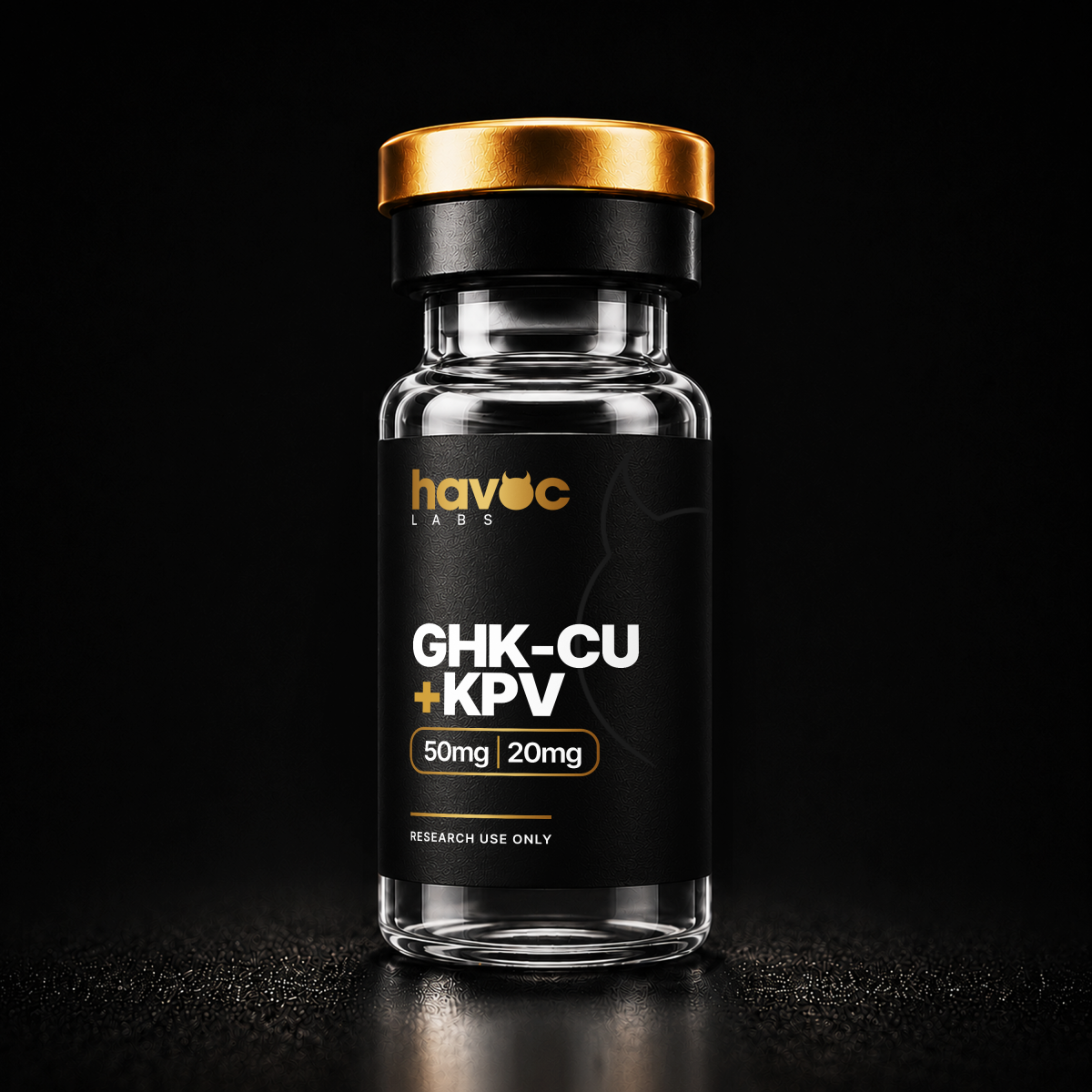
GHK-Cu + KPV
GHK-Cu + KPV

£39.99

Add to basket This product has multiple variants. The options may be chosen on the product page

GHK-Cu + KPV

£39.99

  • UK Stock
  • Secure Payments
  • Discreet UK Delivery

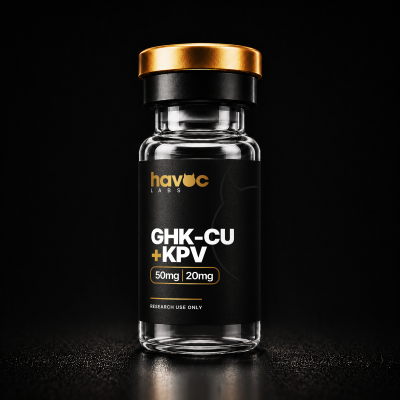
GHK-Cu + KPV combines copper-complexed GHK with the KPV tripeptide in a lyophilised research blend. See the selected variation for its current specification. Not for human or veterinary use.

COMPLETE YOUR KIT

Bacteriostatic Water - 3ml

In stock

£3.99
Semax - 10mg
Semax - 10mg

In stock

£19.99
1 Vial
£39.99
1 Vial
£35.99 Save 10%
3 Vials
£33.99 Save 15%
5 Vials
£31.99 Save 20%

For in vitro laboratory research only.
Not for human or veterinary use. Not for diagnosis, treatment, cure, or prevention of any disease. No dosage, administration, or injection guidance is provided.

GHK-Cu + KPV is a two-component blend supplied as lyophilised research material. It combines the copper-complexed GHK tripeptide with KPV, a tripeptide studied in experimental inflammatory-signalling models.

Research material only
This material is not supplied as a medicine, treatment, supplement or consumer product. It is not for human or veterinary use, consumption or administration, and is not intended to diagnose, treat, cure or prevent any disease.

Blend overview

Blend componentsGHK-Cu + KPV
GHK peptide backboneGly-His-Lys
GHK-Cu reference formGHK complexed with copper(II)
KPV reference sequenceLys-Pro-Val
Component research contextExtracellular matrix and inflammatory signalling
Supplied formLyophilised research blend

Research context

GHK-Cu has been examined in experimental connective-tissue and matrix studies. KPV has been investigated in cell cultures and mouse intestinal-inflammation models, including work on PepT1-mediated uptake and inflammatory signalling.

The cited studies concern individual components, not this combined preparation. They do not establish blend synergy, chemical compatibility, stability or clinical effectiveness. Experimental outcomes depend on the model, material specification and conditions used; findings cannot automatically be transferred to a mixture.

This blend has no single peptide sequence or molecular mass. Copper coordination, counterions, terminal chemistry and the composition of the selected variation matter when interpreting analytical results. Verify the current component specification and batch documentation before designing an experiment.

Batch documentation

Independent analytical documentation is published where available for specific batches and variations. Match the blend identity, selected variation, component specification and batch identifier to the corresponding report before relying on any result. A published result indicator is not a claim of sterility or suitability for human use.

Supply and laboratory handling

  • Supplied in the variation selected above; consult its current component specification.
  • Provided as a lyophilised research blend.
  • Keep the vial sealed and protected from moisture, heat and direct light.
  • Use suitable laboratory controls and independently verify component identity and concentration for the intended experimental model.

Frequently asked questions

What does this blend contain?

GHK-Cu and KPV. Check the current selected variation and batch documentation for the component specification.

Is GHK-Cu the same as copper-free GHK?

No. GHK-Cu refers to the copper complex of the Gly-His-Lys peptide. Copper coordination and chemical form must be considered when identifying the material.

What is KPV?

The Lys-Pro-Val tripeptide studied in experimental inflammatory-signalling research.

Do individual studies prove that the blend works synergistically?

No. Separate component findings do not establish the behaviour, stability or effects of a combined preparation.

Which sizes are available?

Current variations and availability are shown above. Use the specification for the selected variation; this reference description is not tied to a fixed vial size or composition.

Are laboratory results available?

Check the COA tab for matching records. No result indicator means no product-specific published result is currently displayed for that variation.

How should the material be stored?

See the Storage Guidelines tab and follow any batch-specific instructions. No human dosing, administration or injection guidance is provided.

Information reviewed 27 September 2026. Component reference sources: Maquart et al., 1993 (GHK-Cu) and Dalmasso et al., 2008 (KPV).

Size

70mg

Batch-specific analytical documentation

Independent analytical results are published for selected Havoc Labs products, vial sizes and batches. The result attached to one variation must not be treated as evidence for a different size or batch.

  • Result available: a published report is available for the marked variation.
  • Test pending: a sample has been submitted, but no completed result is being claimed.
  • No indicator: no product-specific result is currently displayed for that variation.

Check the identifiers

Always match the compound, vial size and batch reference on the product to the corresponding laboratory record. Where the laboratory provides an independent verification facility, use it to confirm the report.

Browse published lab results →

Storage and stability

Storage requirements can vary by compound, physical form, intended storage duration and batch. Follow the lot-specific documentation and your laboratory’s validated procedure wherever these are available.

Form Suggested storage Important note
Sealed lyophilised material Keep in a cool, dry place, refrigerated at 2–8°C or frozen, as appropriate for the compound and intended storage period. Keep sealed, dry and protected from direct light. Follow compound- and batch-specific documentation and avoid repeated temperature cycling.
Reconstituted solution Refrigerate at 2–8°C unless the applicable laboratory protocol specifies otherwise. Stability depends on the preparation conditions, solvent, concentration, container and handling. No universal storage period is claimed.

No universal shelf-life is claimed

Do not assume a fixed expiry or prepared-solution storage period unless it is supported by relevant stability data or batch documentation. Where a lot-specific document gives different instructions, that document takes precedence.

Published research

The papers below concern GHK-Cu or KPV individually in experimental models. They are component references, not studies of this GHK-Cu + KPV blend. They do not establish synergy, stability, compatibility, clinical effectiveness or safety of the combined preparation.

  1. Maquart FX et al. GHK-Cu and connective-tissue accumulation in experimental rat wounds. Journal of Clinical Investigation, 1993;92(5):2368–2376. Animal study using an experimental wound-chamber model. GHK-Cu exposure was associated with changes in connective-tissue measures, including collagen and glycosaminoglycan content. This paper studied GHK-Cu, not KPV or the blend, and does not establish a human wound-treatment benefit. DOI: 10.1172/JCI116842. View on PubMed ↗
  2. Dalmasso G et al. PepT1-mediated tripeptide KPV uptake reduces intestinal inflammation. Gastroenterology, 2008;134(1):166–178. Study of intestinal epithelial and immune-cell cultures, with mouse colitis models. Investigated PepT1-mediated KPV uptake and reported effects on NF-κB/MAPK signalling and inflammatory measures. KPV-only mechanistic and animal evidence, not a clinical trial or a test of GHK-Cu + KPV. DOI: 10.1053/j.gastro.2007.10.026. View on PubMed ↗
  3. Kannengiesser K et al. Melanocortin-derived tripeptide KPV has anti-inflammatory potential in murine models of inflammatory bowel disease. Inflammatory Bowel Diseases, 2008;14(3):324–331. Mouse intestinal-inflammation research examining KPV and its mode of action. Reported reductions in inflammatory measures in the tested models. Does not test the copper-peptide blend or establish human efficacy or safety. DOI: 10.1002/ibd.20334. View on PubMed ↗

Literature is not batch evidence

The cited studies concern defined individual-component materials and conditions. They do not establish the identity, purity, composition, stability or performance of a Havoc Labs blend batch. Match the selected variation, component specification and batch identifier against the applicable analytical documentation.

References reviewed 27 September 2026.