5-Amino-1MQ
5-Amino-1MQ

£29.99

Add to basket This product has multiple variants. The options may be chosen on the product page

5-Amino-1MQ

£29.99

  • UK Stock
  • Secure Payments
  • Discreet UK Delivery

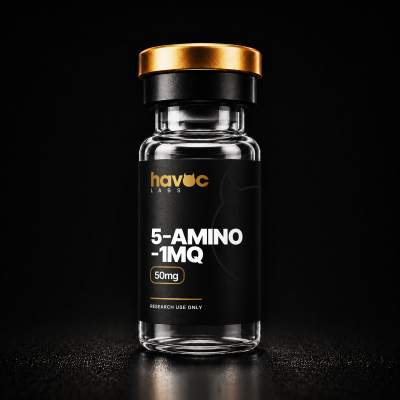
5-Amino-1MQ is a small-molecule quinolinium NNMT inhibitor supplied as a solid research material for enzyme-inhibition, nicotinamide-metabolism, methyl-donor and metabolic-pathway research.

COMPLETE YOUR KIT

Bacteriostatic Water - 3ml

In stock

£3.99
MOTS-c - 10mg
MOTS-c - 10mg

In stock

£24.99
1 Vial
£29.99
1 Vial
£26.99 Save 10%
3 Vials
£25.49 Save 15%
5 Vials
£23.99 Save 20%

For in vitro laboratory research only.
Not for human or veterinary use. Not for diagnosis, treatment, cure, or prevention of any disease. No dosage, administration, or injection guidance is provided.

5-Amino-1MQ is a small-molecule quinolinium inhibitor of nicotinamide N-methyltransferase (NNMT), supplied as a solid research material for controlled studies of enzyme inhibition, nicotinamide metabolism, methyl-donor pathways and cellular metabolic signalling.

Research material only

This material is not supplied as a medicine, treatment, supplement or consumer product. It is not for human or veterinary use, consumption or administration, and is not intended to diagnose, treat, cure or prevent any disease.

Compound overview

Compound5-Amino-1MQ
Full name5-Amino-1-methylquinolinium iodide
Research classSmall-molecule NNMT inhibitor
Research targetNicotinamide N-methyltransferase
Reference formulaC10H11IN2
Reference molecular massApproximately 286.11 Da

Research context

5-Amino-1MQ is the common shorthand for 5-amino-1-methylquinolinium, frequently studied as its iodide salt. NNMT catalyses methyl transfer from S-adenosyl-L-methionine to nicotinamide, producing 1-methylnicotinamide and S-adenosyl-L-homocysteine.

Published experimental work has examined quinolinium NNMT-inhibitor structure–activity relationships, enzyme selectivity, cellular metabolite responses, analytical measurement and diet-induced-obesity models in rodents. This evidence is predominantly preclinical and provides compound-level context only; it does not establish the identity, performance or suitability of the material supplied on this page.

Batch documentation

Independent analytical documentation is published where available for specific batches and variations. A result indicator appears only when a published record is available. Match the vial size and batch identifier to the corresponding report before relying on any result.

Supply and laboratory handling

  • Supplied in the quantity selected above.
  • Provided as a solid small-molecule material for laboratory research.
  • Use calibrated equipment and an independently validated protocol appropriate to the intended study.
  • Record the product designation, quantity, batch identifier and preparation conditions in the laboratory record.

Frequently asked questions

What is 5-Amino-1MQ?

5-Amino-1MQ is a quinolinium small molecule commonly studied as an inhibitor of nicotinamide N-methyltransferase.

Is 5-Amino-1MQ a peptide?

No. It is a small-molecule quinolinium compound rather than an amino-acid peptide.

What is NNMT?

Nicotinamide N-methyltransferase is a cytosolic enzyme that transfers a methyl group from S-adenosyl-L-methionine to nicotinamide. It is studied in relation to nicotinamide, NAD+ and methyl-donor metabolism.

Which chemical form is referenced?

The overview refers to 5-amino-1-methylquinolinium iodide, with the reference formula C10H11IN2 and molecular mass of approximately 286.11 Da. Confirm the stated form against the applicable batch documentation.

What research is linked on this page?

The Research tab links to compound-identification data and published enzyme, structure–activity, analytical, cellular and rodent-model studies. These sources provide scientific context and are not product-performance claims.

Which quantities are available?

Current quantities and availability are shown in the selector above. This information updates with the product variations rather than being fixed in the description.

Are published laboratory results available?

Where a published batch record exists, a result indicator appears beside the applicable variation and the corresponding documentation is available on the lab-results page. No indicator means that no product-specific published result is currently displayed for that variation.

How should 5-Amino-1MQ be stored?

Protect sealed material from light, moisture and repeated temperature changes. After preparing a solution, store it refrigerated at 2–8°C where compatible with the validated laboratory protocol and documented solvent system.

Information reviewed 29 August 2026.

Size

50mg

Batch-specific analytical documentation

Independent analytical results are published for selected Havoc Labs products, vial sizes and batches. The result attached to one variation must not be treated as evidence for a different size or batch.

  • Result available: a published report is available for the marked variation.
  • Test pending: a sample has been submitted, but no completed result is being claimed.
  • No indicator: no product-specific result is currently displayed for that variation.

Check the identifiers

Always match the compound, vial size and batch reference on the product to the corresponding laboratory record. Where the laboratory provides an independent verification facility, use it to confirm the report.

Browse published lab results →

Storage and stability

Storage requirements can vary by compound, physical form, intended storage duration and batch. Follow the lot-specific documentation and your laboratory’s validated procedure wherever these are available.

Form Suggested storage Important note
Sealed lyophilised material Keep in a cool, dry place, refrigerated at 2–8°C or frozen, as appropriate for the compound and intended storage period. Keep sealed, dry and protected from direct light. Follow compound- and batch-specific documentation and avoid repeated temperature cycling.
Reconstituted solution Refrigerate at 2–8°C unless the applicable laboratory protocol specifies otherwise. Stability depends on the preparation conditions, solvent, concentration, container and handling. No universal storage period is claimed.

No universal shelf-life is claimed

Do not assume a fixed expiry or prepared-solution storage period unless it is supported by relevant stability data or batch documentation. Where a lot-specific document gives different instructions, that document takes precedence.

Published research

The sources below concern 5-amino-1-methylquinolinium/5-Amino-1MQ and NNMT inhibition under the materials and experimental conditions used by their authors. They provide compound-level scientific context and do not establish the identity, purity, performance or suitability of any supplied batch.

  1. PubChem. 5-Amino-1-methylquinolinium iodide — Compound Summary, CID 66522933. Reference structure, formula, identifiers and computed molecular mass for the iodide salt. View on PubChem ↗
  2. Neelakantan H et al. Structure-Activity Relationship for Small Molecule Inhibitors of Nicotinamide N-Methyltransferase. Journal of Medicinal Chemistry, 2017. Enzyme-inhibition, docking and structure–activity research on quinolinium and related NNMT-inhibitor scaffolds. View on PubMed ↗
  3. Neelakantan H et al. Selective and membrane-permeable small molecule inhibitors of nicotinamide N-methyltransferase reverse high fat diet-induced obesity in mice. Biochemical Pharmacology, 2018. Cellular selectivity, metabolite and diet-induced-obesity mouse-model research including 5-amino-1MQ. View on PubMed ↗
  4. Awosemo O et al. Development and validation of LC-MS/MS assay for 5-amino-1-methyl quinolinium in rat plasma: Application to pharmacokinetic and oral bioavailability studies. Journal of Pharmaceutical and Biomedical Analysis, 2021. Analytical-method and rat pharmacokinetic research. View on PubMed ↗
  5. Babula JJ et al. Nicotinamide N-methyltransferase inhibition mitigates obesity-related metabolic dysfunction. Diabetes, Obesity and Metabolism, 2024. Pharmacokinetic, tissue-distribution and diet-induced-obesity mouse-model research with 5A1MQ. View on PubMed ↗

Evidence is preclinical

The cited findings come from biochemical assays, cultured cells and animal models. They do not establish safety or efficacy in humans and do not establish the identity, purity or performance of the material supplied on this page. Confirm the chemical form, stated mass and batch identifier against the applicable analytical documentation.