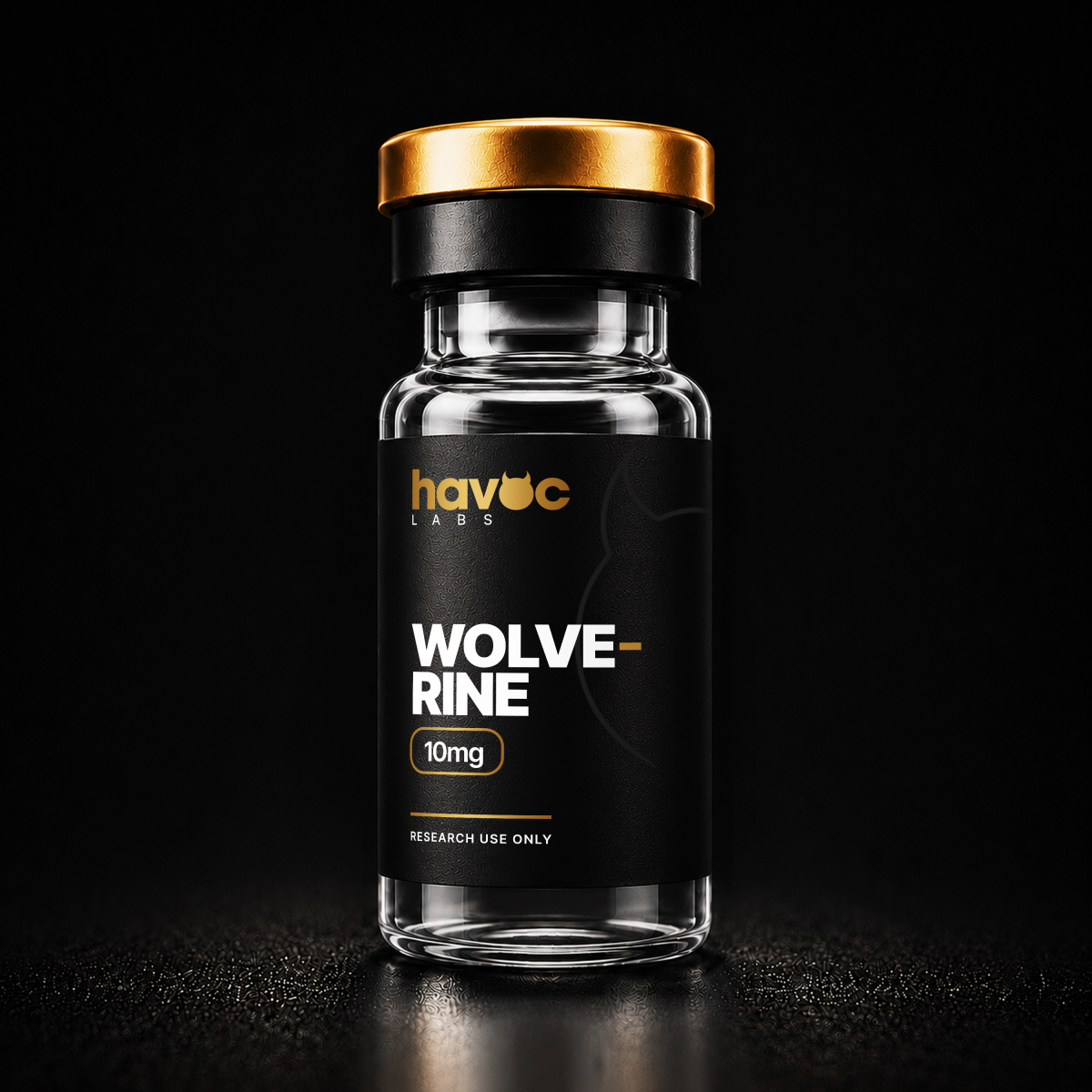
Wolverine Stack is a two-component research blend labelled BPC-157 and TB-500, supplied as lyophilised material in a vial. Select the listed 10mg or 20mg vial option for the nominal total content.
For laboratory research only. This material is not a medicine, treatment, supplement or consumer product. Not for human or veterinary use. No clinical outcome is implied by the product name or by the research discussed below.
Blend overview
Product typeTwo-component peptide research blend
Labelled componentsBPC-157 and TB-500
Vial options10mg or 20mg nominal total content; select the required option above
FormLyophilised material in a vial
Research context
BPC-157 has been investigated in preclinical models including rat tendon injury and cultured tendon cells. Thymosin beta-4 has been studied in experimental wound-healing and cell-migration models. These component studies do not establish the behaviour, safety or efficacy of this particular blend.
TB-500 is a research-market designation. Studies of full-length thymosin beta-4 should not be taken as proof that a material labelled TB-500 is chemically identical; confirm the identity specified for the applicable batch.
Batch documentation
Review any available, lot-matched analytical documents through the batch testing page. A published paper or certificate for a different material or batch does not verify the contents of this vial.
Supply and laboratory handling
- Supplied as the selected vial option; confirm the label and batch documentation on receipt.
- Keep sealed and protected from light and moisture, following a validated laboratory storage procedure.
- Use appropriate laboratory technique and record lot-specific handling conditions.
Frequently asked questions
What is in Wolverine Stack?
It is labelled as a blend of BPC-157 and TB-500 in a single vial. The 10mg and 20mg selections describe nominal total vial content, not a stated quantity of each component. Consult the relevant label or batch record for component-specific details.
Do the cited studies test this blend?
No. The published research listed in the Research tab concerns individual named components or related molecules under the cited authors’ conditions, not this exact two-component formulation.
Is TB-500 the same as thymosin beta-4?
TB-500 is used as a research-market designation. The thymosin beta-4 literature provides context only and does not independently establish the identity of this product’s TB-500 component.
Is this product intended for personal use?
No. It is supplied for laboratory research only and is not for human or veterinary use.
Information reviewed: 28 September 2026.
Batch-specific analytical documentation
Independent analytical results are published for selected Havoc Labs products, vial sizes and batches. The result attached to one variation must not be treated as evidence for a different size or batch.
- Result available: a published report is available for the marked variation.
- Test pending: a sample has been submitted, but no completed result is being claimed.
- No indicator: no product-specific result is currently displayed for that variation.
Check the identifiers
Always match the compound, vial size and batch reference on the product to the corresponding laboratory record. Where the laboratory provides an independent verification facility, use it to confirm the report.
Browse published lab results →
Storage and stability
Storage requirements can vary by compound, physical form, intended storage duration and batch. Follow the lot-specific documentation and your laboratory’s validated procedure wherever these are available.
| Form |
Suggested storage |
Important note |
| Sealed lyophilised material |
Keep in a cool, dry place, refrigerated at 2–8°C or frozen, as appropriate for the compound and intended storage period. |
Keep sealed, dry and protected from direct light. Follow compound- and batch-specific documentation and avoid repeated temperature cycling. |
| Reconstituted solution |
Refrigerate at 2–8°C unless the applicable laboratory protocol specifies otherwise. |
Stability depends on the preparation conditions, solvent, concentration, container and handling. No universal storage period is claimed. |
No universal shelf-life is claimed
Do not assume a fixed expiry or prepared-solution storage period unless it is supported by relevant stability data or batch documentation. Where a lot-specific document gives different instructions, that document takes precedence.
Component research
Wolverine Stack is a BPC-157 and TB-500 research blend. The sources below concern BPC-157 or full-length thymosin beta-4 under the cited experimental conditions. They are not studies of this exact two-component vial formulation and do not establish the identity, purity, performance or suitability of a supplied batch.
- Staresinic M et al. Gastric pentadecapeptide BPC 157 accelerates healing of transected rat Achilles tendon and in vitro stimulates tendocytes growth. Journal of Orthopaedic Research, 2003. Rat tendon injury and cultured tendocyte research concerning BPC-157. View on PubMed ↗
- Hsieh MJ et al. Therapeutic potential of pro-angiogenic BPC157 is associated with VEGFR2 activation and up-regulation. Journal of Molecular Medicine, 2017. Experimental work on BPC-157 and vascular signalling; not a clinical study of this blend. View on PubMed ↗
- Malinda KM et al. Thymosin beta4 accelerates wound healing. Journal of Investigative Dermatology, 1999. Experimental full-length thymosin beta-4 research, provided as context for the TB-500 designation. View on PubMed ↗
- Grant DS et al. Thymosin beta4 enhances endothelial cell differentiation and angiogenesis. Angiogenesis, 1999. Full-length thymosin beta-4 research in endothelial models. View on PubMed ↗
Component literature is not blend or batch evidence
No study of this exact Wolverine Stack formulation is cited. TB-500 is a research-market designation; the thymosin beta-4 papers do not establish that the material supplied under that designation is identical. Neither these papers nor the product name demonstrate human safety or efficacy. Confirm component identity and nominal contents against the applicable lot-matched documentation.
References reviewed 28 September 2026.