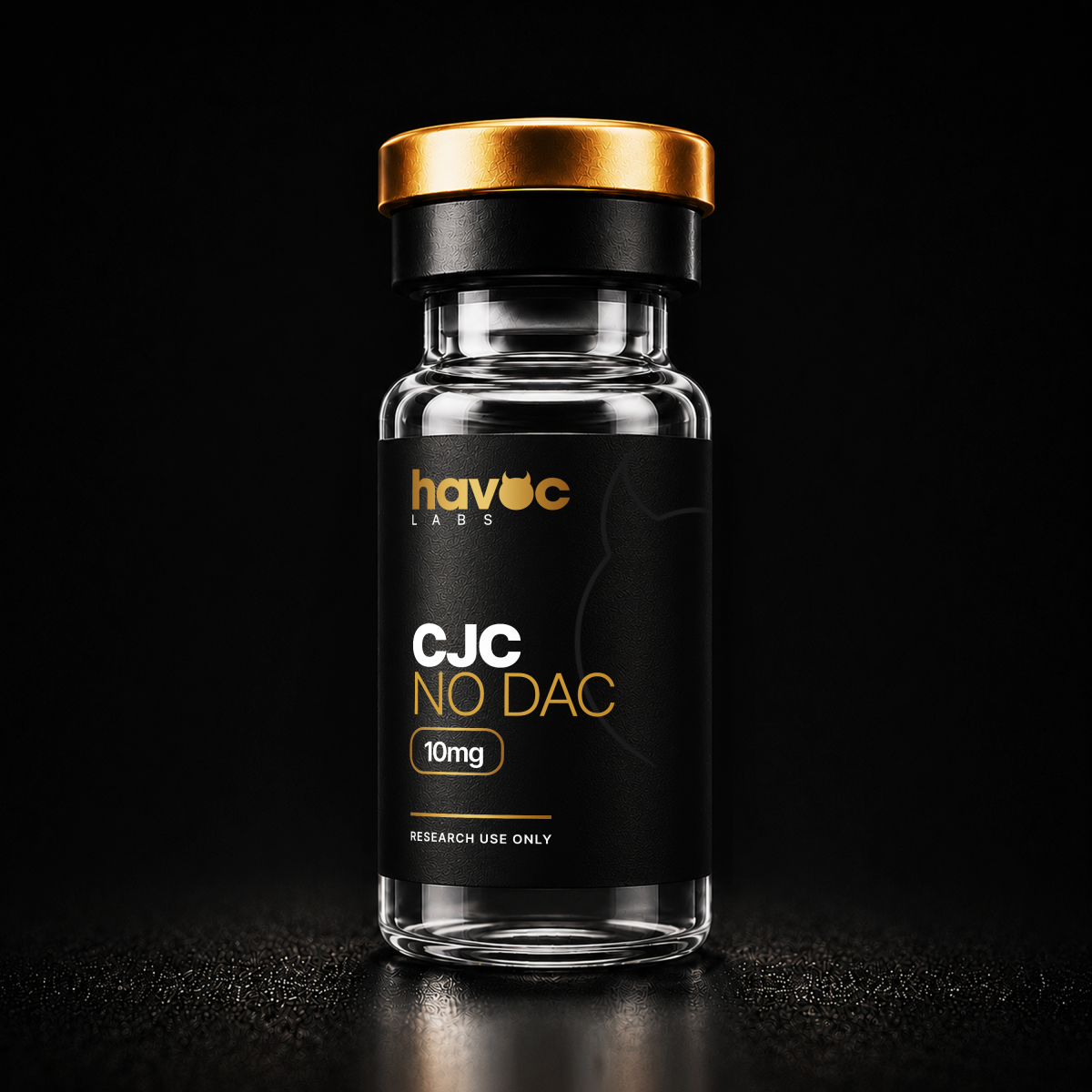
CJC-1295 (No DAC)
CJC-1295 (No DAC)

Price range: £24.99 through £34.99

Add to basket This product has multiple variants. The options may be chosen on the product page

CJC-1295 (No DAC)

Price range: £24.99 through £34.99

  • UK Stock
  • Secure Payments
  • Discreet UK Delivery

CJC-1295 (No DAC), also known as Modified GRF (1-29), is a synthetic GHRH analogue supplied lyophilised for laboratory research.

COMPLETE YOUR KIT

Bacteriostatic Water - 3ml

In stock

£3.99
GHK-Cu - 50mg
GHK-Cu - 50mg

In stock

£19.99
1 Vial
£24.99
1 Vial
£22.49 Save 10%
3 Vials
£21.24 Save 15%
5 Vials
£19.99 Save 20%

For in vitro laboratory research only.
Not for human or veterinary use. Not for diagnosis, treatment, cure, or prevention of any disease. No dosage, administration, or injection guidance is provided.

This product is currently sold out!

No worries! Please enter your e-mail address and we will promptly notify you as soon as the item is back in stock.

Great! You have been added to the waitlist for this product. Please check your inbox and confirm the subscription to this waitlist.

CJC-1295 (No DAC), also known as Modified GRF (1-29), is a synthetic 29-amino-acid analogue of growth-hormone-releasing hormone (GHRH), supplied as a lyophilised research material. It is used in laboratory studies of GHRH-receptor signalling and peptide structure.

Research material only
This material is not supplied as a medicine, treatment, supplement or consumer product. It is not for human or veterinary use, consumption or administration, and is not intended to diagnose, treat, cure or prevent any disease.

Compound overview

Compound classSynthetic 29-amino-acid GHRH analogue
Reference sequenceTyr-D-Ala-Asp-Ala-Ile-Phe-Thr-Gln-Ser-Tyr-Arg-Lys-Val-Leu-Ala-Gln-Leu-Ser-Ala-Arg-Lys-Leu-Leu-Gln-Asp-Ile-Leu-Ser-Arg-NH₂
Molecular formulaC₁₅₂H₂₅₂N₄₄O₄₂
Reference molecular mass3367.95 g/mol
CAS reference446036-97-1 (free base)
Research pathwayGHRH-receptor signalling

Research context

The No DAC peptide contains substitutions at positions 2, 8, 15 and 27 of GRF (1-29). It lacks the albumin-binding drug affinity complex (DAC) modification. No DAC and DAC materials are distinct chemical entities; findings from studies of the DAC form should not be assumed to apply to this product.

The formula and molecular mass above describe the reference peptide free base. Counterions, water content and formulation can affect the supplied material. Reference information does not establish a vial’s identity, purity or suitability for a particular experiment; consult the matching batch documentation.

Batch documentation

Independent analytical documentation is published where available for specific batches and variations. A result indicator appears only when a published record is available. Match the compound, vial size and batch identifier to the corresponding report before relying on any result.

Supply and laboratory handling

  • Supplied in the vial size selected above.
  • Provided as a lyophilised research material.
  • Keep the vial sealed and protected from moisture, heat and direct light.
  • Use suitable laboratory controls and independently verify identity and concentration for the intended experimental model.

Frequently asked questions

What is CJC-1295 (No DAC)?

A modified GHRH fragment, also called Modified GRF (1-29), supplied here for laboratory research.

How does No DAC differ from With DAC?

The No DAC form has no albumin-binding DAC modification. Use documentation specific to the selected form rather than treating the two as interchangeable.

What does the reference sequence describe?

The 29-residue, C-terminally amidated reference peptide. D-Ala identifies the D-alanine residue at position 2; the full sequence is listed in the compound overview.

Which vial sizes are available?

Current selectable vial sizes and availability are shown above. These controls update automatically as variations change.

Are laboratory results available?

A shield appears beside a variation only when a published result is available. No indicator means that no product-specific result is currently displayed for that variation. Check the COA tab for available records.

How should the material be stored?

See the Storage Guidelines tab for the current handling guidance for sealed lyophilised material and reconstituted solution. Follow any batch-specific instructions supplied with the material.

Information reviewed 27 September 2026. Reference: FDA scientific review of CJC-1295-related substances (chemical identification and distinction between No DAC and DAC forms).

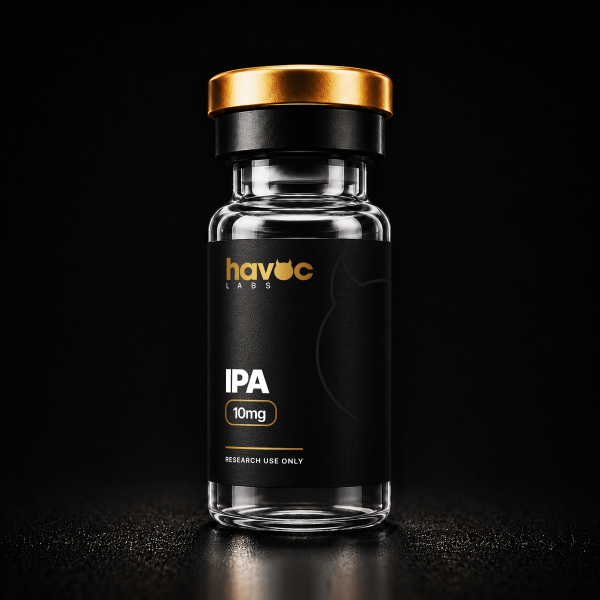
Size

5mg, 10mg

Batch-specific analytical documentation

Independent analytical results are published for selected Havoc Labs products, vial sizes and batches. The result attached to one variation must not be treated as evidence for a different size or batch.

  • Result available: a published report is available for the marked variation.
  • Test pending: a sample has been submitted, but no completed result is being claimed.
  • No indicator: no product-specific result is currently displayed for that variation.

Check the identifiers

Always match the compound, vial size and batch reference on the product to the corresponding laboratory record. Where the laboratory provides an independent verification facility, use it to confirm the report.

Browse published lab results →

Storage and stability

Storage requirements can vary by compound, physical form, intended storage duration and batch. Follow the lot-specific documentation and your laboratory’s validated procedure wherever these are available.

Form Suggested storage Important note
Sealed lyophilised material Keep in a cool, dry place, refrigerated at 2–8°C or frozen, as appropriate for the compound and intended storage period. Keep sealed, dry and protected from direct light. Follow compound- and batch-specific documentation and avoid repeated temperature cycling.
Reconstituted solution Refrigerate at 2–8°C unless the applicable laboratory protocol specifies otherwise. Stability depends on the preparation conditions, solvent, concentration, container and handling. No universal storage period is claimed.

No universal shelf-life is claimed

Do not assume a fixed expiry or prepared-solution storage period unless it is supported by relevant stability data or batch documentation. Where a lot-specific document gives different instructions, that document takes precedence.

Published research

The sources below provide reference information for CJC-1295 (No DAC), also called Modified GRF (1-29), and research context from related GHRH/GRF peptides. Each entry identifies the material studied. Related-analogue and DAC findings are not direct evidence for the No DAC material supplied here.

  1. US Food and Drug Administration. Scientific review of CJC-1295-related substances. Pharmacy Compounding Advisory Committee briefing document, 2024. Reference sequence, molecular formula, mass and identifiers for the 29-residue free-base peptide; distinguishes it from DAC forms. This is a scientific review, not a primary experimental study. View FDA review ↗
  2. Lance VA et al. Super-active analogs of growth hormone-releasing factor (1-29)-amide. Biochemical and Biophysical Research Communications, 1984;119(1):265–272. Comparative animal research on GRF(1-29) analogues, including a D-Ala substitution at position 2. Related-analogue context; not a study of the exact four-substitution No DAC peptide. DOI: 10.1016/0006-291X(84)91647-4. View on PubMed ↗
  3. Soule S, King JA and Millar RP. D-Ala2 substitution and metabolic clearance of GHRH-(1-29) in normal men. Journal of Clinical Endocrinology & Metabolism, 1994;79(4):1208–1211. Controlled human pharmacokinetic research comparing GHRH-(1-29)-NH₂ with its D-Ala2 analogue. This single-substitution peptide is not identical to Modified GRF (1-29); its clearance and half-life measurements should not be assigned to this product. DOI: 10.1210/jcem.79.4.7962295. View on PubMed ↗
  4. Jetté L et al. hGRF(1-29)–albumin bioconjugates and the identification of CJC-1295 as a long-lasting GRF analogue. Endocrinology, 2005;146(7):3052–3058. Peptide-development research in cultured rat pituitary cells and rats. The selected CJC-1295 construct included an albumin-binding C-terminal modification (DAC). Included for development and structural context; its prolonged action is not evidence for the No DAC form. DOI: 10.1210/en.2004-1286. View on PubMed ↗

Literature is not batch evidence

The cited papers concern defined experimental materials and conditions, including related analogues and DAC constructs. They do not establish the identity, purity, performance or suitability of a Havoc Labs batch. Match the No DAC designation, reference structure and batch identifier against the applicable analytical documentation.

References reviewed 27 September 2026.