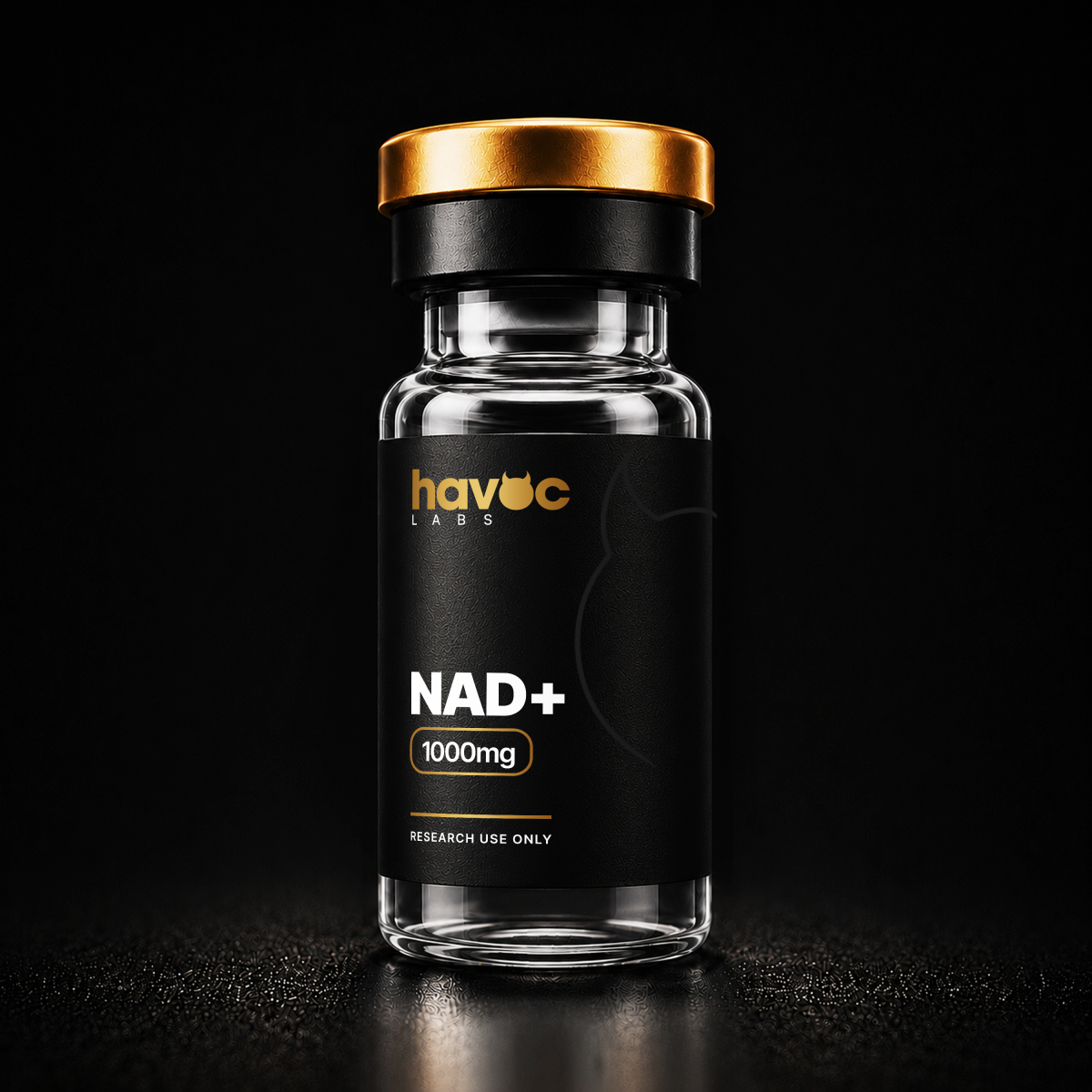
NAD+ (oxidised nicotinamide adenine dinucleotide) is a pyridine dinucleotide coenzyme supplied as a lyophilised research material for controlled studies of cellular redox balance, energy metabolism, NAD-dependent enzymes and ADP-ribosylation pathways.
Research material only
This material is not supplied as a medicine, treatment, supplement or consumer product. It is not for human or veterinary use, consumption or administration, and is not intended to diagnose, treat, cure or prevent any disease.
Compound overview
CompoundNAD+
Full nameOxidised nicotinamide adenine dinucleotide
Research classPyridine dinucleotide coenzyme
Redox pairNAD+ / NADH
Reference molecular massApproximately 663–664 Da, ionic form dependent
FormLyophilised material
Research context
NAD+ is an oxidised dinucleotide coenzyme that participates in electron-transfer reactions through the NAD+/NADH redox pair. It is also consumed as a substrate by enzyme families including sirtuins, poly(ADP-ribose) polymerases and CD38-related enzymes, linking NAD metabolism with cellular signalling, protein modification and DNA-damage-response research.
Published experimental work has examined changes in cellular NAD+ availability in relation to metabolic signalling, nuclear–mitochondrial communication, nucleotide metabolism and NAD-consuming enzymes. These studies provide compound-level context only and do not establish the identity, performance or suitability of the material supplied on this page.
Batch documentation
Independent analytical documentation is published where available for specific batches and variations. A result indicator appears only when a published record is available. Match the vial size and batch identifier to the corresponding report before relying on any result.
Supply and laboratory handling
- Supplied in the vial size selected above.
- Provided as a lyophilised material for laboratory research.
- Use calibrated equipment and an independently validated protocol appropriate to the intended study.
- Record the product designation, vial size, batch identifier and preparation conditions in the laboratory record.
Frequently asked questions
What is NAD+?
NAD+ is the oxidised form of nicotinamide adenine dinucleotide, a pyridine dinucleotide coenzyme involved in cellular redox reactions and used as a substrate by several NAD-dependent enzyme families.
What is the NAD+/NADH redox pair?
NAD+ can accept electrons to form NADH, while NADH can donate electrons and return to the oxidised NAD+ form. This reversible pair is widely studied in cellular energy metabolism and redox biology.
Which vial sizes are available?
Current vial sizes and availability are shown in the size selector above. This information updates with the product variations rather than being fixed in the description.
Are published laboratory results available?
Where a published batch record exists, a result indicator appears beside the applicable variation and the corresponding documentation is available on the lab-results page. No indicator means that no product-specific published result is currently displayed for that variation.
How should NAD+ be stored?
Protect sealed lyophilised material from light, moisture and repeated temperature changes. After reconstitution, store the reconstituted solution refrigerated at 2–8°C and follow a validated laboratory protocol for handling and use.
Information reviewed 29 August 2026.
Batch-specific analytical documentation
Independent analytical results are published for selected Havoc Labs products, vial sizes and batches. The result attached to one variation must not be treated as evidence for a different size or batch.
- Result available: a published report is available for the marked variation.
- Test pending: a sample has been submitted, but no completed result is being claimed.
- No indicator: no product-specific result is currently displayed for that variation.
Check the identifiers
Always match the compound, vial size and batch reference on the product to the corresponding laboratory record. Where the laboratory provides an independent verification facility, use it to confirm the report.
Browse published lab results →
Storage and stability
Storage requirements can vary by compound, physical form, intended storage duration and batch. Follow the lot-specific documentation and your laboratory’s validated procedure wherever these are available.
| Form |
Suggested storage |
Important note |
| Sealed lyophilised material |
Keep in a cool, dry place, refrigerated at 2–8°C or frozen, as appropriate for the compound and intended storage period. |
Keep sealed, dry and protected from direct light. Follow compound- and batch-specific documentation and avoid repeated temperature cycling. |
| Reconstituted solution |
Refrigerate at 2–8°C unless the applicable laboratory protocol specifies otherwise. |
Stability depends on the preparation conditions, solvent, concentration, container and handling. No universal storage period is claimed. |
No universal shelf-life is claimed
Do not assume a fixed expiry or prepared-solution storage period unless it is supported by relevant stability data or batch documentation. Where a lot-specific document gives different instructions, that document takes precedence.
Published research
The sources below concern nicotinamide adenine dinucleotide and NAD+ biology under the materials and experimental conditions used by their authors. They provide compound-level scientific context and do not establish the identity, purity, performance or suitability of any supplied batch.
- PubChem. Nadide — Compound Summary, CID 5893. Reference identifiers, structure and computed properties for an NAD+ reference entry. View on PubChem ↗
- Cantó C et al. AMPK regulates energy expenditure by modulating NAD+ metabolism and SIRT1 activity. Nature, 2009. Cellular and mouse skeletal-muscle research examining AMPK, NAD+ availability and SIRT1-dependent signalling. View on PubMed ↗
- Gomes AP et al. Declining NAD+ induces a pseudohypoxic state disrupting nuclear-mitochondrial communication during aging. Cell, 2013. Cell and mouse-model research into NAD+-dependent nuclear–mitochondrial signalling. View on PubMed ↗
- Camacho-Pereira J et al. CD38 dictates age-related NAD decline and mitochondrial dysfunction through an SIRT3-dependent mechanism. Cell Metabolism, 2016. Mouse and cellular research examining CD38, NAD+ availability and mitochondrial signalling. View on PubMed ↗
- Munk SHN et al. NAD+ regulates nucleotide metabolism and genomic DNA replication. Nature Cell Biology, 2023. Cell-culture research examining exogenous NAD+, mitochondrial activity, nucleotide pools and replication responses. View on PubMed ↗
Experimental literature is not product or clinical evidence
The cited findings include cultured-cell and animal-model work and do not establish safety or efficacy in humans. They also do not establish the identity, purity or performance of the material supplied on this page. Confirm the stated form and batch identifier against the applicable analytical documentation.